

Join the Million Mani Club!
Million Mani Club News
Million Mani Club Member Update
Congratulations to Nicolás Bayón Spinadel in Argentina, who joined the Million Mani Club in 2025 and reported his two-millionth mani in January 2026! Our super-reciter Sonam Wangmo, a longtime local member of the PTC sangha, last checked in at 29 million earlier this month.
And we have a new installment of longtime PTC sangha member Dan Gussin’s story as he continues to navigate with grace, courage, and honesty a rare and difficult cancer diagnosed in late 2024. Even as he grapples with recent bad news and setbacks, Dan reports that mani recitation and other dharma practices help give him a sense of stability and ease in the midst of physical pain and emotions that can sometimes feel overwhelming. Dan is a member of the PTC Million Mani Club since 2023, and reached three million during Losar 2026. Congratulations Dan! You can read his story by scrolling down this page; the new installment, February 2026, is at the end. You can also find stories from other Million Mani Club members on our archive page.
Save the date: PTC Losar 2026 Millon Mani Challenge begins Wednesday February 18!
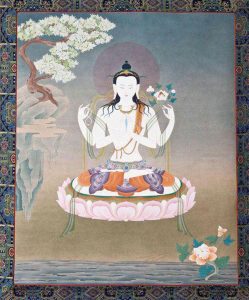
Chenrezig painting by
HH Seventeenth Karmapa
Ogyen Trinley Dorje
Our next official PTC Million Mani Challenge will be for Losar 2026, the first month of the Tibetan Year of the Fire Horse. Losar begins Wednesday, February 18, and will continue through Thursday, March 19. As always, the merit of all our activity is vastly multiplied during the entire month, especially at and for a few days before and after the full moon on Tuesday, March 3. Please join us in reciting manis during this very auspicious time. You can report mani subtotals any time using the form on this page.
Last year we recited a total of 4,815,089 manis together during Losar and Saga Dawa. We weren’t able to host a formal mani challenge for Lhabab Duchen in November but a lot of manis were reported at that time in honor of Lhabab Duchen, and I’m sure we passed 5 million for the year. And whatever the challenge total, it doesn’t count all the manis that are reported between challenges!
PST Six Paramitas Challenge for 2026!
Our affiliated center in Richmond, Virginia, Palpung Shenpen Tharchin, aka Palpung-Richmond, is studying the six paramitas during 2026, with two months devoted to each paramita. All are welcome to join us in the practice and also on the first Thursday of each month via Zoom from 7:00 to about 7:30pm for discussion of the current paramita. For more information on the paramita challenge and to join PST’s Thursday evening practice and discussion, please visit the event page on the PST website. And for a brief explanation of how to practice the current and previous paramitas, visit Lama Chodron’s website.
Scroll down for more information on how to recite and count manis. If you have any questions that aren’t answered there, email us at manicoordinator at gmail.com.
Check out our home page for upcoming events and regular in-person and online classes. Check out our Million Mani Club Member Update below, and our archive page for challenge totals over the past few years along with the stories of some of our members.
What is the Million Mani Club?
Established in 2012, the PTC Million Mani Club now has 27 members, each of whom has cumulatively reported at least a million recitations of the mantra of compassion, om mani peme hung, through our online mani tracker. Several members have accumulated multiple millions. Visit our Million Mani Club Member list for more information, and we look forward to welcoming you to the club when you complete your first million. Manis can be counted not only during challenges but any time, and each time you report, you will immediately receive an email with an updated count of your lifetime total.
Some of our Million Mani Club members have shared some thoughts and history about their recitation of the mani mantra. Scroll down for the latest contribution by Dan Gussin of NYC, a longtime member of the PTC sangha, and read other stories here in our Million Mani Club archive.
Click on any of the headings below for more information and for tips on reciting and counting manis.
What is a Mani?
Mani is short for the sacred six-syllable mantra of the bodhisattva of compassion, Chenrezig or Avalokiteshvara. Chenrezig’s form represents, embodies, and radiates the fully awakened compassion of all the buddhas — which is also innate in our own minds. We too are said to be buddha in essence, the union of wisdom and compassion. Reciting the mani mantra helps remove obscurations to manifesting our fully awakened nature, and sends postive compassionate energy into the world.
The mantra may be pronounced either om mani peme hung (Tibetan pronunciation) or om mani padme hum (Sanskrit pronunciation). When we recite it, we maintain the aspiration to free all sentient beings from suffering, and can also include any specific people or animals we know to be suffering in any situation. We can also recite it in response to our own suffering. It is traditionally said that any being — human, animal, insect, or invisible being — who hears this mantra even once will eventually attain freedom from suffering and the full awakening of a buddha.
Om mani peme hung is the most commonly recited mantra in Tibet. Everyone knows it, even young children, and many elderly Tibetans who can no longer work spend their days reciting manis for the benefit of their loved ones and all beings. Prayer wheels are often filled with mani mantras.
If you’d like to learn more about Chenrezig and the sacred power of the mani mantra, we highly recommend Bokar Rinpoche’s book Chenrezig Lord of Love.
What is Merit?
Reciting manis (or any other mantra) is a powerful way to accumulate merit, which, along with wisdom, is one of the “two wings of awakening.” Merit is the positive energy that fuels our dharma practice and all our activities to benefit beings, and is an important factor in eliminating obstacles of all kinds in our practice and our lives. Lama Norlha Rinpoche always emphasized the need to engage in meritorious activity if we truly want to free ourselves and others from suffering and fully awaken to our true nature.
Other ways to accumulate merit include all dharma practice; engaging in any of the six paramitas or perfections such as generosity, patience, and joyful diligence; circumambulating stupas and sacred spaces and objects; supporting monasteries, dharma centers, and practitioners through donations, offering food, and other types of help; sponsoring dharma activities and sacred images; helping other beings in any ways we can, large and small; and even rejoicing in the merit and good fortune of others.
We hope you will accumulate vast amounts of merit through reciting manis and other beneficial activities! In particular, participating in group practice, such as PTC’s million mani challenges offered once or twice a year, is an especially powerful way to accumulate merit, because it is said that each participant earns merit equivalent to that of the entire group.
We Will Help You Count!
You can report your mani accumulation on this page at any time, always using the same email address each time you report your numbers. Our system will automatically organize your entries. If a sangha or group is accumulating manis together, the collective total can be reported using a single email address for the group, or you can track your manis individually, keep your own group count, and let us know by email when your group has reached a million.
Each time you report, your subtotal will be automatically added to your previous count and you will receive an email confirmation with your current total along with a history of previous numbers you’ve submitted.
If you have questions or need support at any point, you can email the Million Mani Club Coordinator.
When you reach a million manis, we’ll add your name to the official roll of the Million Mani Club. If you accumulate another million, we’ll acknowledge both achievements.
How To Count Mantras
Using a mala: It’s traditional to count mantra recitations using a string of 108 prayer beads that is similar to a rosary. Even though there are 108 beads, each round is counted as just 100, to allow for errors and moments of distraction. Malas can be found at dharma shops online, or in the Palpung Thubten Choling bookstore when the monastery is open.
Mechanical counters: A variety of mechanical tally counters can also be found online. This type of counter can be held in the hand and pressed to register each mantra. There are also various styles of counters you can wear on a finger. These can be found by searching for “prayer counter.”
Phone apps: There are also smartphone apps specifically for keeping track of mantra accumulations. One of the best counting methods we’ve found is using the stopwatch function on a smartphone. Start the stopwatch when you begin, pause it if you get interrupted, and when you hit “stop” you’ll have a precise record of how long you recited. You can then calculate how many mantras you’ve accumulated by using the method below in “counting by time.” You can also use the stopwatch as an aid to figuring out how many mantras you recite on average per minute.
Counting by time: For those who prefer to track mantra recitations by time, or in case of a physical limitation or activity such as driving or washing dishes that makes using a mala or counter difficult, this is another option. You will need to use a mala or counter or pencil on paper to determine how long it takes on average for you to recite 100 mantras, and you can then do the math and track mantra totals according to the length of your recitation period. When this method is used, it’s important to make sure you are reciting continuously and at an even speed so your count isn’t overestimated. If you realize you have become distracted, you can adjust your total to take that into account.
Formal Meditation and Practice Texts
The best and most powerful way to recite manis is during formal practice on the chair or cushion, when your full attention can be clearly focused for a period of time. To further empower your recitation, we recommend doing it within the context of the three aspects of genuine Vajrayana practice: refuge and bodhicitta, the main practice, and dedication of merit to all beings. If you already do the practice of Chenrezig, the bodhisattva of compassion, you can count all mantras recited during your regular practice. If you don’t already have a text, you may download three English versions of the Chenrezig practice: full-length, medium, and abbreviated. Some people prefer to chant in Tibetan and you may use that text as well. Either language is fine: the practice in Tibetan is said to carry the blessings of all the generations of practitioners who have realized Chenrezig through chanting it, while the practice in English connects us directly with the meaning.
Informal Recitation in Daily Life
It’s also very beneficial to recite manis as you go about your daily activities. It’s easy to recite manis while walking, driving, or waiting for something, and they can also transform any routine activity that doesn’t require full attention, such as household or outdoor tasks, into dharma practice. Manis can even be counted while watching TV, as long as we are careful to keep an accurate count. Reciting manis while circumambulating a stupa or engaging in other virtuous activity is merit upon merit!
Occasionally we are asked if it’s okay to count manis recited during sleep and dreams. Unfortunately, since we are not able to count mantras reliably in these circumstances, we don’t include them in our total. But if you do find yourself reciting manis while you are sleeping, it is certainly an auspicious sign!
As with formal practice, the benefit of informal recitation is also strengthened if we remember to renew our refuge and bodhicitta at the beginning and dedicate the merit at the end. This can be done with traditional prayers, in our own words, or just by remembering our intention.
A note about volume: When alone or with others who enjoy hearing mantras, it’s fine to recite aloud. In fact, it’s considered very beneficial for animals, insects, and other beings to hear mantras, especially om mani peme hung. In public or within earshot of others who might not be receptive to Buddhist mantras, it’s best to recite silently or in a barely audible voice (traditionally described as “to the shirt collar,” meaning no one can hear it but you).
Group Recitation
We are taught that when we practice or recite mantras together as a group (with a local or online sangha, or as part of an organized group recitation such as Palpung New York’s million-mani initiatives, which are open to everyone), the benefit and merit of our individual recitation is multiplied by the number of participants. So we encourage group practice whenever feasible, in addition to the ongoing benefit of individual recitation.
The Mani Habit
We hope you will join us in benefiting beings and earning merit by reciting the mantra of compassion om mani peme hung and keeping track of your numbers through the mani counter on this page. And if you continue reciting manis over time, we very much look forward to welcoming you to the Palpung New York Million Mani Club.
The more opportunities we find to recite manis throughout the day, the more we develop a habit of reciting them, and soon we may find ourselves reciting manis in the back of our mind without even thinking about it. This is an illustration of how we can turn our typically samsaric propensity to form habits into a positive momentum toward enlightenment.
About the Million Mani Club
The Palpung Thubten Choling Million Mani Club was established in December 2012, when our monastery sangha joined together with the aspiration to accumulate one million recitations of the mantra of compassion, om mani peme hung, to benefit the long life, health, and well-being of our teachers and all sentient beings. The word spread quickly, and with the participation of practitioners all over the world, within just a few weeks we far surpassed our original goal, reaching a collective total of five million manis!
Since then we have recited over a million manis together on numerous other occasions, especially during the Buddhist holy months and days when merit is vastly multiplied, including Losar, the Tibetan New Year; Saga Dawa, the anniversary of Shakyamuni Buddha’s birth, enlightenment, and parinirvana; and Lhabab Duchen, when the Buddha is said to have descended back to earth after teaching in the gods’ realm where his mother resided.
Over more than a decade, hundreds of participants have benefited sentient beings and earned merit (momentum toward enlightenment) by reciting mani mantras during our group challenges and on their own, and reporting them through the online mani tracker on this page. Over two dozen have become members of the PTC Million Mani Club by reciting at least a million manis.
We invite you to join the club! All you have to do is recite manis at your own pace and track them using our online mani tracker. Designed by Dean Hill for our very first mani challenge in 2012, it not only records your current mani count but also reports your cumulative total back to you by email, along with your entire mani-reporting history.
Record your mani mantra recitations here
Million Mani Club Members
Congratulations to all our Million Mani Club members!
| Name | Location | Year |
| Rebecca Cheng | 1M 2012 | |
| Dean Hill | New York | 1M 2013 |
| Linda Jordan | New Hampshire | 6M since 2013 |
| Ellen Eylers | New York | 1M 2014 |
| K.D. | 1M 2014 | |
| Tania Dennis Corbo | 1M 2014 | |
| Anthony Ferreira | New York | 1M 2015 |
| Candace Chaite | New Mexico | 1M 2015 |
| Enrique Pagan | 1M 2015 | |
| Jian | 1M 2015 | |
| Susan Bagley | New Zealand | 1M 2015 |
| Tashi Drolma | United Kingdom | 1M 2015 |
| Walt Thompson | Massachusetts | 1M 2015 |
| Ray Furminger | United Kingdom | 3M since 2016 |
| Jim Streit | New York | 2M since 2016 |
| Joe Mikrut | 1M 2017 | |
| Kathleen Beecher | Maine | 3M since 2018 |
| Jampa Thaye | Australia | 2M since 2020 |
| Keith Luck | Virginia | 4M since 2021 |
| Su Sagarino | California | 3M since 2022 |
| John Fallon | New York | 1M 2022 |
| Eric Swanson | New York | 1M 2022 |
| Dan Gussin | New York | 3M 2023 |
| Sonam Wangmo | New York | 29M since 2023 |
| JoAnn Voigt | Florida | 2M since 2024 |
| Andy Yale | Maine | 1M 2024 |
| Nicolás Bayón Spinadel | Argentina | 2M 2025 |
| Keven Long | Texas | 3M since 2025 |
| Jake Moore | Michigan | 1M 2025 |
Below is Dan Gussin’s story of his unexpected ordeal with a rare cancer that began a year ago in September 2024. It’s sequential so the latest installment is at the bottom of the page. Dan, please know that we’re all wishing you well and praying for your well-being and for the recovery of your health as soon as possible.
From Dan Gussin of NYC, Losar 2025:
In September 2024 I was diagnosed with cancer, a large tumor in my upper left leg. Not only was this a shock, I also had a great deal of self recrimination as I had been in pain for some time but thought it stemmed from my cerebral palsy and was not serious.
Waking up the morning after my initial emergency room visit, my primary doctor set up for a CAT scan. Part of me just wanted to pull the blanket over my head and cry. As I lay there, almost automatically I started to do basic shamatha meditation on my breath. This gave me just enough mental space to start reciting manis. I honestly could not begin to focus on a practice text but this recitation of manis was able to calm my mind enough to begin taking care of some immediate phone calls that couldn’t wait.
My first call was to my supervisor at work, who needed to be aware of my situation. As I dialed, I almost burst into tears as she was the first person I told about my tumor other than my wife, who had been with me at the hospital. I was able, barely, to go back to doing manis, which helped me remain stable enough to make it through that conversation. I am very fortunate that my supervisor has been very kind and supportive from this first step, and has demonstrated genuine bodhicitta and compassion throughout my illness.
I had to get a biopsy to confirm what type of cancer I have. That week between the biopsy and the diagnosis felt like a year. I was having trouble meditating but was able to focus on doing manis until I could remind myself that there is no such thing as a bad meditation, and anything you experience is just part of the path.
Of course, when my wife and I met with the oncologist, he did not have a confirmed diagnosis as it was difficult to pin down what type of cancer I have. I wanted to scream! All that emotional stress and I was called in just to tell me to wait. Again, I went back to the simplicity and yet so profound meditation on my breath and mani recitation .
Several days later I got a confirmed diagnosis of a somewhat rare cancer. Follow-up scans showed that the tumor was wrapped around my leg bone and had blood vessels burrowing through it. Between learning of this and sharing my situation with my parents, friends and co-workers, this was a very stressful time.
Again, being able to go back to reciting manis helped keep me on an even keel. It wasn’t about the number of manis. It was the connection with compassion for myself and others that manis will create if done with the proper motivation and intent. It was about the mental space that manis allow to develop that lead to open awareness and the ability to remain more calm as the storm of thoughts threaten to rage through your mind. It is about being able to be more in touch with the people around you, who are also suffering, as they are also caught in the stormy ocean of samsara.
That is what a regular recitation of manis has done for me and so many others. I am not special in this regard, and anyone can apply this in their own life. I hope my path and my suffering can help others. I will share more of my journey soon with the sincere wish that it might help ease the suffering of sentient beings.
Blessings along the path.
Dan Gussin
Update to Dan’s story, April 2025:
After a grueling process of chemotherapy, including being admitted to the hospital and rehab for
six weeks due to a rare, negative reaction to the chemotherapy meds, I was discharged home. Because I can’t be left alone, I have been staying with my parents as my wife, Debbie, works full time.Just this week, I had a surgical consult. As you might imagine, my monkey mind was churning with thoughts of major surgery or even amputation as possible options. As my wife and I were in a taxi heading to the surgeon, we saw a deer along the side of the road. My mind, which had been all over the place, flashed on the deerskin Chenrezig wears and the compassion Chenrezig embodies. This gave me just enough mental space to begin reciting manis and reflecting on compassion for myself and all those suffering from cancer.
While it was a difficult day and the options discussed with my surgeon were unpleasant, being able to recite manis and rest in open awareness made this experience much more bearable. In turn, I was able to help ease the pain my wife and parents were caught up in due to my illness.
Not only did my reciting manis help me, it also led to a ripple effect that helped ease the suffering of those around me. I hope my suffering can be of some benefit to others, and I dedicate any merit I have gained to those suffering from illness and to their caregivers.
Blessings along the path.
Dan Gussin
June 2025 – My road has become a bit more uncertain.
For the last month I have been on a hiatus from treatment as my last round of chemotherapy meds get flushed from my body. Because I have reached my lifetime limit of this medication, its now time for a change. The difficulty is, what option is the better choice for me: radiation, oral chemotherapy, more IV chemo?
I have a CAT and MRI scan tomorrow and an appointment with my oncologist on Monday. As you might imagine, this is quite stressful and an anxious time for me and those around me. Yet, in this storm of Samsara, there is a positive aspect of having cancer and its resulting suffering. It can and has acted like jet fuel for my Dharma practice. And at the core of my practice is the recitation of Manis. My cancer has been a springboard for contemplation on impermanence, emptiness, open awareness and tonglen. And the springboard for this contemplation is Shamata and Manis.
Simple and yet very profound, Manis have helped me calm my mind and not fall into the raging river of thoughts and emotions that could so easily overwhelm me. And Manis give me enough mental stability and space to engage in other Dharma practices.
Of course I have stress, fear, pain and anxiety. This is part of life until Awakening and I can feel far from that some days. But I have also seen how I have been able to shorten my falls into this river and how these falls can be less intense than without consistent practice and Mani Recitation.
Although at times very difficult, bringing adversity onto the path can lead to a strengthening of our connection to the Dharma and ease not only our suffering but the suffering of those around us.
I am not unique or special in any way and each of us has Buddha Nature at our core and the ability to bring the adversaries we face onto the path of awakening. As Mingur Rinpoche has said, to make these adversaries our friends.
I hope that my suffering, in some small way, can benefit all sentient Beings and they they all achieve perfect, unsurpassed Enlightenment.
Blessings along the Path
Dan GussinDan Gussin
September 2025
It’s been over a year now since I started on this journey with cancer. To say that it’s been stressful, with many unexpected twists and turns, would be an understatement.
One of the most profound aspects of this path is how my Buddhist practice has changed and yet remained close to my heart and an integral part of my self care and healing. And at the very heart of my engagement with the Dharma has been the simple and yet so very profound mani.
Waking up in the hospital after my very scary negative reaction to the IV chemotherapy medication, I had been stripped of all the ritual items many of us use to support our reflection and meditation on the teachings of the Buddha. No water bowls to fill, no statues to inspire me, no candles or incense. All of this was gone and while it had been almost a week before I woke up, for me, this felt so very immediate, visceral and like a punch in the gut. Not only was I in serious medical trouble, I didn’t have the physical toolkit that I had always had to bolster my daily practice during difficult times. As I stared up at the ceiling in my hospital room, my mind was in turmoil and in a very scary place.
Over the next few days, even as my family and friends showed me incredible loving kindness and compassion, I continued to feel stymied and realized that I had become too dependent on the external aspects of my practice. Without these aids, I needed to take a deep breath and reset my application of the Dharma in my life. In essence, the rubber had met the road.
Because of the physical pain and cognitive confusion I was experiencing, any kind of longer meditation was out of the question.What remained was the simplicity of the mani and its immediate, positive impact on my mental and emotional state. So, I recited a lot of mani’s and did notice improvement in maintaining a more stable and open mind.
Then my cancer threw me a curveball.
Instead of IV chemotherapy a few days a week followed by two weeks or so to recover, I have been put on a daily oral chemotherapy pill. So, since June, I have not gotten even a day’s break from the side effects of my treatment. Because I am at risk for falls and my wife works full time, I had to move in with my parents. So not only is there the day-to-day grind of side effects, I still don’t have the external tools and paraphernalia of my practice to help me get through all this.
What I do have is the internal foundation of practice and understanding of the Dharma I have built over the years. And, as always, at the very core of my practice is mani recitation and the self-compassion and healing of Chenrezi.
I still have many moments of being uncertain and scared about what lies ahead. But I have also seen the enormous benefit that mani’s have had on my life and on the people around me. We all have Buddha Nature at our core and each of us has the potential to benefit equally from the Buddhist path.
I hope, in some small way, my suffering can help others to navigate this stormy sea of samsara.
Blessings along the Path
DanDan Gussin
February 2026
“It has been a difficult time since I last wrote about my journey with cancer. And yet, from a dharma perspective, it has also been a time of greater understanding of the Buddhist teachings and how to apply them more effectively in my daily life.
Starting in June 2025, I was put on an oral chemotherapy medication for about three months. Unfortunately, I was not responding to this treatment and the tumors in my leg and lungs grew. I was then put back on IV chemotherapy, but after two rounds of treatment, my tumors still showed some growth.
At my oncologist’s suggestion, I had a consultation with a doctor at Memorial Sloan Kettering who specializes in the type of cancer I have. I then transferred from Northwell Health to MSK for my care. This became more complex than it should have been, and took some time to organize. While a positive step, this transfer also came with very unsettling news: “Your cancer is incurable. We can help you to live a good life but we can’t completely get rid of it. There are several options to help you live as long as possible, but it’s not something we can heal completely.”
This was the first time I had heard the word “incurable” and it hit me like a punch in the gut. And yet, while sitting in the exam room and working to process this, I was able to softly start reciting manis as my doctor laid out possible treatments moving forward. This recitation of manis gave me just enough mental and emotional space to be able to rest in open awareness. It was still very emotionally painful, but I was able to observe becoming anxious rather than completely falling into the raging river of thoughts and sensations I was feeling.
My new oncologist set up CAT and MRI scans to help me get a clear, up-to-date assessment of my status. This was done on January 29th with a follow up visit with my oncologist and a third infusion set for February 2nd. I continued to recite manis during the scans and the days before my visit with my oncologist. While these few days were anxious, the manis gave me the means to connect with meditation on impermanence, emptiness and seeing life as a dream, all of which helped keep my mind more stable in the middle of the sweeping storm of thoughts and the physical sensations that always accompany them.
Then, on the day of my appointment to assess my current status, samsara threw me another curve ball. Somehow, my previous scans done at Northwell in November had gotten lost in the system, and now my oncologist at MSK did not have anything to compare my current scans with. Based solely on the radiology report, it looks as if my tumors may have grown and there is concern that my current treatment may not be working. The problem is that different radiologists use different landmarks in the body to assess growth, and without the actual images, a definitive assessment is not possible. My oncologist is working to find the lost scans and wants to regroup and discuss further treatment options next week. She is also setting up a referral to the MSK pain management team to help with my increasing leg pain.
Engaging in open awareness combined with meditation on emptiness and impermanence have helped with the pain but it is still becoming a quality of life issue, and I might need a different pain medication. On top of that, my actual infusion was delayed by over 2 hours, so I got home very late. Because of the uncertainty of the situation, we all decided to go through with my scheduled infusion, as I’ve been tolerating them well and they might be having some positive effect. Again the recitation of manis acted as a connection to the dharma foundation I had built over the years, and made all this less stressful.
Sitting in the office, looking at the scans of my body being destroyed from the inside, I felt the knife edge of panic as another option looks like it’s being taken away. The counterpoint to this was having my oncologist discuss regrouping and resetting and having several different options moving forward that gave me hope.
The very confusing part about this is the other part of myself that was able to rest in open awareness and recite manis during this helpless panicked feeling. It’s like cognitive dissonance at a very deep level and a glimpse of my essential Buddha Nature. And then there is impermanence. In some ways the ground is shifting under my feet so fast I can barely keep up, but isn’t that the very nature of the teaching itself?
The waters of the ocean of samsara are so very rough right now, and sometimes the emotional and physical pain borders on the unthinkable. Two nurses took my vitals and they looked good both times; so it does seem as if the dharma kicked in on a strictly physical level. Admittedly, there is a medication component to this, but I do think the dharma was a large part of it. And at the very core of my dharma practice is the simple yet so profound mani recitation.
I am so very scared and yet at the core of this fear is a profound calm and understanding that I am okay. The problem is, my monkey mind is jumping back and forth between the two, and it’s exhausting. But again, this is a normal part of the path. I’m angry at Northwell, Epic and maybe MSK for not having all my scans, but at the same time I’m aware these are flawed samsaric beings caught in a large and complex system not of their making.
I am also having difficulty forgiving myself for assuming my initial pain was not serious but just an injury, and waiting until my tumor was quite large before seeing my doctor at the very start of this journey. I am working on self-compassion. Sometimes I feel very trapped; at other times my mind feels at ease and I even find humor and joy and feel very close to my Buddha Nature. I sometimes fall into the raging river of my mind head first, but I have proof positive that the Dharma works. And if I were not sick, I wouldn’t need the hospital and medicine of the Buddhist path. So again, this seems like a normal part of the path because of where I am now.
As you can see, I have a lot going on in my head and body right now. I am both okay with not being okay, and just not okay, depending on what time of day you ask. And yet I feel safe and curious about what will happen next. It’s all part of turning confusion into clarity and working with my karma as best I can, and allowing things to unfold naturally without judgment or the storylines of past and future. The pain, fear, and anger I feel can be very seductive and all too easy to get caught in, and I don’t want to become that. So I am staying very close to my dharma practice. Manis have served as a core component for my practice and have helped me maintain a stability of mind I would not have had otherwise.
One of the most important aspects of the mani recitation and this stability of mind is that they allow me to engage in bodhichitta. It can become all too easy to become very self centered in the midst of intense suffering and uncertainty. But I have seen how the ripple effect of my practice has had a healing effect on my wife, parents, and friends. Not only have manis helped me, they have helped others around me to find some peace of mind and healing as they accompany me during this difficult journey we are on together.
All of this is a work in progress for me and filled with pain and setbacks. But, as I have said before, my cancer has also acted like jet fuel for my connection to the dharma and a time of growth and exploration of my mind.
I hope that, in some small way, my path can help ease the suffering of others and show how Buddhadharma is always available to help navigate the ocean of samsara and make progress toward transforming the afflictive emotions we all face. Tai Situ Rinpoche has said even a one percent improvement in this life is very beneficial. I find this very inspiring as I continue along the bodhisattva path.
All the best and blessings along the path,
Dan
Invitation from the PTC mani coordinator: If anyone else would like to share a story or comments about what motivates you to recite manis and how you feel it benefits you and others, please email us at manicoordinator@gmail.com. Here’s an archive of previously shared stories.