

Join the Million Mani Club!
Million Mani Club News
PTC 2026 Sagadawa Million Mani Challenge May 16-June 14
Earn Vastly Multiplied Merit and Help Bring Peace to the World
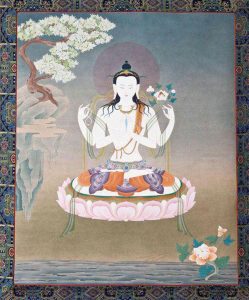
Chenrezig painting by
HH Seventeenth Karmapa
Ogyen Trinley Dorje
We invite you to join us in our second Million Mani Challenge of 2026 during the holy month of Sagadawa, commemorating Shakyamuni Buddha’s birth, enlightenment, and parinirvana, from Saturday May 16 through June 14. During this Tibetan lunar month, the merit of all our dharma practice and positive actions to help others is vastly multiplied, peaking at the full moon May 31. PTC’s resident sangha will be practicing eight consecutive two-day sets of Nyungne (the fasting ritual and meditation of Thousand-Armed Chenrezig) from May 16 to June 1. Offerings to support this activity are another way to earn vast amounts of merit during Sagadawa.
All are welcome to join us, whether you’ve recited manis before or not. How to do it is explained below, and you can use the handy online mani tracker on this page to report your manis any time.
Million Mani Club Member Update
Congratulations to longtime PTC community member Sonam Wangmo, also known as Jill Michele Sawick, who recently passed the amazing milestone of 30 million manis! Not only that, but she has recited them all in two and a half years, since November 2023, when she participated in PTC’s Lhabab Duchen Million Mani Challenge and just kept going. The photo below was taken in early 2020 at the opening of the ninth cycle of three-year retreat at Palpung Thubten Choling, in which she was a participant.
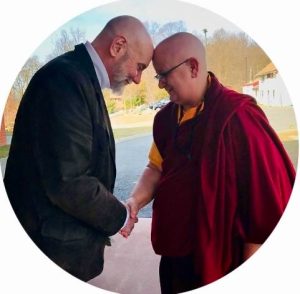
Sonam Wangmo kindly agreed to share some thoughts about her mani journey with us on this noteworthy occasion, and you can scroll to the bottom of this page to read it, along with her previous comments on reciting manis from January 2024 after she reached her third million. You can find other contributions from various mani club members on our archive page, including Dan Gussin’s inspiring saga of how mani recitation is currently helping him deal with cancer. Contributions are shared in chronological order, from oldest to most recent.
PST Six Paramitas Challenge for 2026!
Our affiliated center in Richmond, Virginia, Palpung Shenpen Tharchin, aka Palpung-Richmond, is studying the six paramitas during 2026, with two months devoted to each paramita. All are welcome to join us in the practice and also on the first Thursday of each month via Zoom from 7:00 to about 7:30pm for discussion of the current paramita. For more information on the paramita challenge and to join PST’s Thursday evening practice and discussion, please visit the event page on the PST website. And for a brief explanation of how to practice the current and previous paramitas, visit Lama Chodron’s website.
Scroll down for more information on how to recite and count manis. If you have any questions that aren’t answered there, email us at manicoordinator at gmail.com.
Check out our home page for upcoming events and regular in-person and online classes. Check out our Million Mani Club Member Update below, and our archive page for challenge totals over the past few years along with the stories of some of our members.
What is the Million Mani Club?
Established in 2012, the PTC Million Mani Club now has 27 members, each of whom has cumulatively reported at least a million recitations of the mantra of compassion, om mani peme hung, through our online mani tracker. Several members have accumulated multiple millions. Visit our Million Mani Club Member list for more information, and we look forward to welcoming you to the club when you complete your first million. Manis can be counted not only during challenges but any time, and each time you report, you will immediately receive an email with an updated count of your lifetime total.
Some of our Million Mani Club members have shared some thoughts and history about their recitation of the mani mantra. Scroll down for the latest contribution by Sonam Wangmo, a longtime member of the PTC sangha, and read other stories here in our Million Mani Club archive.
Click on any of the headings below for more information and for tips on reciting and counting manis.
What is a Mani?
Mani is short for the sacred six-syllable mantra of the bodhisattva of compassion, Chenrezig or Avalokiteshvara. Chenrezig’s form represents, embodies, and radiates the fully awakened compassion of all the buddhas — which is also innate in our own minds. We too are said to be buddha in essence, the union of wisdom and compassion. Reciting the mani mantra helps remove obscurations to manifesting our fully awakened nature, and sends postive compassionate energy into the world.
The mantra may be pronounced either om mani peme hung (Tibetan pronunciation) or om mani padme hum (Sanskrit pronunciation). When we recite it, we maintain the aspiration to free all sentient beings from suffering, and can also include any specific people or animals we know to be suffering in any situation. We can also recite it in response to our own suffering. It is traditionally said that any being — human, animal, insect, or invisible being — who hears this mantra even once will eventually attain freedom from suffering and the full awakening of a buddha.
Om mani peme hung is the most commonly recited mantra in Tibet. Everyone knows it, even young children, and many elderly Tibetans who can no longer work spend their days reciting manis for the benefit of their loved ones and all beings. Prayer wheels are often filled with mani mantras.
If you’d like to learn more about Chenrezig and the sacred power of the mani mantra, we highly recommend Bokar Rinpoche’s book Chenrezig Lord of Love.
What is Merit?
Reciting manis (or any other mantra) is a powerful way to accumulate merit, which, along with wisdom, is one of the “two wings of awakening.” Merit is the positive energy that fuels our dharma practice and all our activities to benefit beings, and is an important factor in eliminating obstacles of all kinds in our practice and our lives. Lama Norlha Rinpoche always emphasized the need to engage in meritorious activity if we truly want to free ourselves and others from suffering and fully awaken to our true nature.
Other ways to accumulate merit include all dharma practice; engaging in any of the six paramitas or perfections such as generosity, patience, and joyful diligence; circumambulating stupas and sacred spaces and objects; supporting monasteries, dharma centers, and practitioners through donations, offering food, and other types of help; sponsoring dharma activities and sacred images; helping other beings in any ways we can, large and small; and even rejoicing in the merit and good fortune of others.
We hope you will accumulate vast amounts of merit through reciting manis and other beneficial activities! In particular, participating in group practice, such as PTC’s million mani challenges offered once or twice a year, is an especially powerful way to accumulate merit, because it is said that each participant earns merit equivalent to that of the entire group.
We Will Help You Count!
You can report your mani accumulation on this page at any time, always using the same email address each time you report your numbers. Our system will automatically organize your entries. If a sangha or group is accumulating manis together, the collective total can be reported using a single email address for the group, or you can track your manis individually, keep your own group count, and let us know by email when your group has reached a million.
Each time you report, your subtotal will be automatically added to your previous count and you will receive an email confirmation with your current total along with a history of previous numbers you’ve submitted.
If you have questions or need support at any point, you can email the Million Mani Club Coordinator.
When you reach a million manis, we’ll add your name to the official roll of the Million Mani Club. If you accumulate another million, we’ll acknowledge both achievements.
How To Count Mantras
Using a mala: It’s traditional to count mantra recitations using a string of 108 prayer beads that is similar to a rosary. Even though there are 108 beads, each round is counted as just 100, to allow for errors and moments of distraction. Malas can be found at dharma shops online, or in the Palpung Thubten Choling bookstore when the monastery is open.
Mechanical counters: A variety of mechanical tally counters can also be found online. This type of counter can be held in the hand and pressed to register each mantra. There are also various styles of counters you can wear on a finger. These can be found by searching for “prayer counter.”
Phone apps: There are also smartphone apps specifically for keeping track of mantra accumulations. One of the best counting methods we’ve found is using the stopwatch function on a smartphone. Start the stopwatch when you begin, pause it if you get interrupted, and when you hit “stop” you’ll have a precise record of how long you recited. You can then calculate how many mantras you’ve accumulated by using the method below in “counting by time.” You can also use the stopwatch as an aid to figuring out how many mantras you recite on average per minute.
Counting by time: For those who prefer to track mantra recitations by time, or in case of a physical limitation or activity such as driving or washing dishes that makes using a mala or counter difficult, this is another option. You will need to use a mala or counter or pencil on paper to determine how long it takes on average for you to recite 100 mantras, and you can then do the math and track mantra totals according to the length of your recitation period. When this method is used, it’s important to make sure you are reciting continuously and at an even speed so your count isn’t overestimated. If you realize you have become distracted, you can adjust your total to take that into account.
Formal Meditation and Practice Texts
The best and most powerful way to recite manis is during formal practice on the chair or cushion, when your full attention can be clearly focused for a period of time. To further empower your recitation, we recommend doing it within the context of the three aspects of genuine Vajrayana practice: refuge and bodhicitta, the main practice, and dedication of merit to all beings. If you already do the practice of Chenrezig, the bodhisattva of compassion, you can count all mantras recited during your regular practice. If you don’t already have a text, you may download three English versions of the Chenrezig practice: full-length, medium, and abbreviated. Some people prefer to chant in Tibetan and you may use that text as well. Either language is fine: the practice in Tibetan is said to carry the blessings of all the generations of practitioners who have realized Chenrezig through chanting it, while the practice in English connects us directly with the meaning.
Informal Recitation in Daily Life
It’s also very beneficial to recite manis as you go about your daily activities. It’s easy to recite manis while walking, driving, or waiting for something, and they can also transform any routine activity that doesn’t require full attention, such as household or outdoor tasks, into dharma practice. Manis can even be counted while watching TV, as long as we are careful to keep an accurate count. Reciting manis while circumambulating a stupa or engaging in other virtuous activity is merit upon merit!
Occasionally we are asked if it’s okay to count manis recited during sleep and dreams. Unfortunately, since we are not able to count mantras reliably in these circumstances, we don’t include them in our total. But if you do find yourself reciting manis while you are sleeping, it is certainly an auspicious sign!
As with formal practice, the benefit of informal recitation is also strengthened if we remember to renew our refuge and bodhicitta at the beginning and dedicate the merit at the end. This can be done with traditional prayers, in our own words, or just by remembering our intention.
A note about volume: When alone or with others who enjoy hearing mantras, it’s fine to recite aloud. In fact, it’s considered very beneficial for animals, insects, and other beings to hear mantras, especially om mani peme hung. In public or within earshot of others who might not be receptive to Buddhist mantras, it’s best to recite silently or in a barely audible voice (traditionally described as “to the shirt collar,” meaning no one can hear it but you).
Group Recitation
We are taught that when we practice or recite mantras together as a group (with a local or online sangha, or as part of an organized group recitation such as Palpung New York’s million-mani initiatives, which are open to everyone), the benefit and merit of our individual recitation is multiplied by the number of participants. So we encourage group practice whenever feasible, in addition to the ongoing benefit of individual recitation.
The Mani Habit
We hope you will join us in benefiting beings and earning merit by reciting the mantra of compassion om mani peme hung and keeping track of your numbers through the mani counter on this page. And if you continue reciting manis over time, we very much look forward to welcoming you to the Palpung New York Million Mani Club.
The more opportunities we find to recite manis throughout the day, the more we develop a habit of reciting them, and soon we may find ourselves reciting manis in the back of our mind without even thinking about it. This is an illustration of how we can turn our typically samsaric propensity to form habits into a positive momentum toward enlightenment.
About the Million Mani Club
The Palpung Thubten Choling Million Mani Club was established in December 2012, when our monastery sangha joined together with the aspiration to accumulate one million recitations of the mantra of compassion, om mani peme hung, to benefit the long life, health, and well-being of our teachers and all sentient beings. The word spread quickly, and with the participation of practitioners all over the world, within just a few weeks we far surpassed our original goal, reaching a collective total of five million manis!
Since then we have recited over a million manis together on numerous other occasions, especially during the Buddhist holy months and days when merit is vastly multiplied, including Losar, the Tibetan New Year; Saga Dawa, the anniversary of Shakyamuni Buddha’s birth, enlightenment, and parinirvana; and Lhabab Duchen, when the Buddha is said to have descended back to earth after teaching in the gods’ realm where his mother resided.
Over more than a decade, hundreds of participants have benefited sentient beings and earned merit (momentum toward enlightenment) by reciting mani mantras during our group challenges and on their own, and reporting them through the online mani tracker on this page. Over two dozen have become members of the PTC Million Mani Club by reciting at least a million manis.
We invite you to join the club! All you have to do is recite manis at your own pace and track them using our online mani tracker. Designed by Dean Hill for our very first mani challenge in 2012, it not only records your current mani count but also reports your cumulative total back to you by email, along with your entire mani-reporting history.
Record your mani mantra recitations here
Million Mani Club Members
Congratulations to all our Million Mani Club members!
| Name | Location | Year |
| Rebecca Cheng | 1M 2012 | |
| Dean Hill | New York | 1M 2013 |
| Linda Jordan | New Hampshire | 7M since 2013 |
| Ellen Eylers | New York | 1M 2014 |
| K.D. | 1M 2014 | |
| Tania Dennis Corbo | 1M 2014 | |
| Anthony Ferreira | New York | 1M 2015 |
| Candace Chaite | New Mexico | 1M 2015 |
| Enrique Pagan | 1M 2015 | |
| Jian | 1M 2015 | |
| Susan Bagley | New Zealand | 1M 2015 |
| Tashi Drolma | United Kingdom | 1M 2015 |
| Walt Thompson | Massachusetts | 1M 2015 |
| Ray Furminger | United Kingdom | 3M since 2016 |
| Jim Streit | New York | 2M since 2016 |
| Joe Mikrut | 1M 2017 | |
| Kathleen Beecher | Maine | 3M since 2018 |
| Jampa Thaye | Australia | 2M since 2020 |
| Keith Luck | Virginia | 4M since 2021 |
| Su Sagarino | California | 3M since 2022 |
| John Fallon | New York | 1M 2022 |
| Eric Swanson | New York | 1M 2022 |
| Dan Gussin | New York | 3M 2023 |
| Sonam Wangmo | New York | 31M since 2023 |
| JoAnn Voigt | Florida | 2M since 2024 |
| Andy Yale | Maine | 1M 2024 |
| Nicolás Bayón Spinadel | Argentina | 2M 2025 |
| Keven Long | Texas | 3M since 2025 |
| Jake Moore | Michigan | 1M 2025 |
May 2026: We asked Sonam Wangmo, aka Jill Michele Sawick, for her thoughts on the occasion of reaching the amazing milestone of 30 million manis. Below is what she shared with us, followed by her earlier comments on reaching previous milestones:
In the beginning of November 2023, I sat down to begin reciting Manis for the monastery’s Lhabab Duchen Million Mani Challenge, an act of shared community offering manis of compassion to all beings. I had no thoughts beyond helping to reach the challenge goal. I didn’t know that I would recite one million manis myself until a few days before month’s end. I realized that with slightly more attention and effort, it would be possible. And then it happened.
That December, I thought it might be nice to continue for a while longer. I sat down and began again. And again and again and again, month after month reciting at least a million manis. It’s a quiet, peaceful practice for me. Every day I take my seat and breathe and recite, counting on my mala through all kinds of finger calluses and chapped lips; eyes open or shut; incense and candle or fresh air through the open window. I visualize Buddhas or deities, shrine rooms, and people in all kinds of circumstances. I might bring to mind troubling scenes: war, politics, poverty, violence. When I start to feel the tightness inside (the energy of anger, judgement, negativity), I rest there to feel it deeply and send love, compassion, understanding, and patience to all these situations. I spend a lot of time working to keep my heart open to the suffering in order to connect through the mutual feelings of all beings.
I’m learning to give myself grace and compassion, things that haven’t been easy for me. And, I’m learning that I can begin again in each moment.
Even though I’m retired and I live alone in an extremely quiet neighborhood, the practice helps me feel the oneness with all beings. Honestly, that’s where I want to be. Now, I can’t imagine being anywhere else.
From the archive, January 2024: During a span of less than three months, Sonam Wangmo of New York accumulated her first three million manis, beginning with our Lhabab Duchen Challenge in November 2023 and reaching her third million in January 2024.
After the first million, we asked what had motivated her to recite so many manis in such a short time. She responded, “With all that’s going on in the world and in so many lives, it seemed like a good time to sow some love and compassion. I’ve decided to keep it up a while longer.”
We checked in again after she completed her second million at the end of the year, and she said, “2023 was a dark and distressing year for me. Whenever I poked my head outside and looked around, I realized that many more people were facing horrific issues of life and death: wildfires, earthquakes, floods, wars, genocide, disease, starvation. When the monastery announced a Mani Challenge in November, I took it as an opportunity to do whatever I could to help as many others as possible, given my own individual obstacles. I made a commitment to practicing Chenrezig and to meditation through mani recitation, as many as I can for as long as I can. I have no plans to meet numbers or times. I’m okay to simply practice.
Invitation from the PTC mani coordinator: If anyone else would like to share a story or comments about what motivates you to recite manis and how you feel it benefits you and others, please email us at manicoordinator@gmail.com. Here’s an archive of previously shared stories.